What would a life without conflict actually look like? I have no idea. I raised five boys, all now in adulthood, but there were some moments, if you know what I mean.
Ironically, I grew up in a home that felt fairly devoid of conflict. I never saw my parents fight. My younger brother and I are very different: I played sports, and he was in Boy Scouts. I am an extrovert; he is introverted and perhaps the most mellow person I know on the planet. My house was peaceful, and I thought that was normal. In fact, I entered marriage as a young pastor believing that my marriage would look just like my parents’, and in that simple expectation, I spent many years believing I was failing.
To pursue that peaceful, conflict-free marriage, I had to become smaller. Vague opinions. Shallow honesty. Staying out of the hard conversation. Even little white lies, told just to avoid disappointing my wife. But that’s not peace, and it’s not the life God created me to live. That’s life without substance: physical, emotional, intellectual, spiritual. Two people who actually believe something will eventually collide. That’s not a flaw. That’s what it looks like when two real people are actually present with each other.
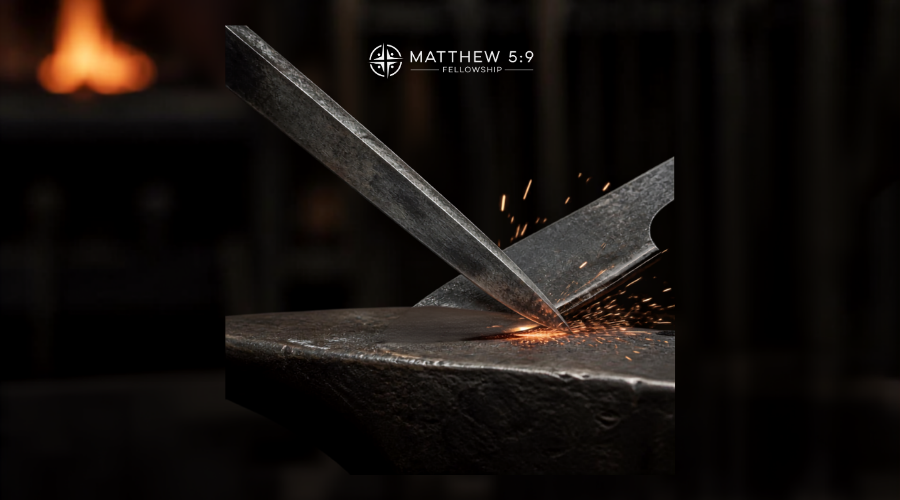
So I’ll say it plainly: I spent years treating conflict as if it were a sin. I could not have been more wrong. It’s inevitable wherever people with real convictions live in real proximity, and under the right conditions, it’s actually beneficial. “As iron sharpens iron, so one person sharpens another” (Proverbs 27:17). Iron doesn’t sharpen iron by agreeing with it. It sharpens through friction.
Ask yourself honestly: who has sharpened you? I’d bet it wasn’t the person who told you what you wanted to hear.
Here’s the picture I keep coming back to, especially now that I spend most of my week coaching pastors through exactly this. An axe brought to the grindstone deliberately is used as it was made to be used, and it comes away sharper. Swung at carelessly, that’s not sharpening. That’s destruction. Same tools, completely different outcome, depending on whether the conflict is submitted to a purpose or just released as force. That’s the difference between conflict and cruelty. Not whether sparks fly, but whether something is actually being shaped.
But that picture needs a caution, or it gets misused. A grindstone isn’t a posture you get to wear into every relationship. It’s a tool you sometimes carry, not an identity you adopt. Treat everyone you love as raw iron that needs sharpening, and you won’t sharpen anyone. You’ll just wear them down until they no longer want to be near you. The grindstone has a time and place, and so does the soft shoulder. Knowing a person well and knowing what they most need in a given moment is part of loving someone well. And that only comes from actually paying attention.
Scripture doesn’t tiptoe around this either. Paul confronts Peter to his face over how Peter was treating Gentile believers (Galatians 2:11–14). That’s public disagreement between two apostles, and the choice they made in that moment either produced kingdom benefit or brokenness. Scripture doesn’t pretend it was easy, and neither should we.
Without conflict, where would your light actually shine? A good attitude is easy when everyone agrees with you. That’s not light. Nobody notices a candle in a room that’s already lit (Matthew 5:13–16). Jesus goes further still. “Eye for eye” was a defensible ethic, and he takes it and says love your enemy instead (Matthew 5:38–48), then asks the question that still stings: If you only love the people who love you back, what reward is there in that?
It’s the same discernment the grindstone requires: knowing someone well enough to bring what they actually need, even when that isn’t what you’d prefer to give. Sometimes love looks like the soft shoulder. Sometimes, in a coaching conversation or in my own marriage, it looks like the grindstone.
Here’s what I keep coming back to, both for myself and for the pastors I sit across from. We were in sharp conflict with God. Not tension. Real, deserved conflict. And Paul tells us exactly how God responded to it: “God was reconciling the world to Himself in Christ, not counting people’s sins against them.” (2 Corinthians 5:17–21). We tend to stop right there, grateful and relieved for what He has done for us. But Paul doesn’t stop there. He goes on to tell us that God has given us the ministry of reconciliation. We are His real-time representatives, His ambassadors.
That’s not just a metaphor. It’s a job description, and it’s the one I try to live inside every time I walk into a conflict, whether it’s in my own home, in a social media post, or in a church I’ve been asked to help. Grace-giving. Open. Thoughtful. Wisdom-seeking. Curious. Honest about anger without being ruled by it. At all times, in every conflict, our calling is to represent the heart of God. Period.
This is where the grindstone actually belongs. Not as its own calling, but as one tool in an ambassador’s hand, alongside the soft shoulder. An ambassador doesn’t walk into a room to sharpen. An ambassador walks in to represent. Some days that means the friction of iron on iron. Most days, if I’m honest, it means the soft shoulder.
But the tool is never the assignment. The assignment is always to represent Him well.
Paul and Barnabas show what that looks like when two ambassadors read the same room differently. Paul reached for the grindstone. Barnabas reached for the soft shoulder. For a while, that difference cost them everything: they went their separate ways over it (Acts 15:36–41). I know what that costs, because I’ve watched pastors and churches pay it. But it didn’t stay that way. Years later, Paul writes that Mark has become useful to him again in ministry (2 Timothy 4:11), useful in part because Barnabas hadn’t given up on him when Paul had. Whatever tore in that first conflict got worked all the way through.
That’s the whole aim, really; not to become a permanent grindstone, and not to become only a soft shoulder either. To read the room in front of me and represent Him well, I have to know which tools to choose.

Dean Kuest
This is not a typical bio I would use to introduce myself to strangers, but ministry is often where we present our best on the “front stage” and hide the dirt “backstage.” Like social media, it is easy to produce the stuff that makes us look great, but I long for relationships that are real…so here is my “honest” bio.
I am a husband of 33 years to my beautiful wife, Leslie. I am a pastor and a PK who raised five PKs (all boys). I am now Pops to five grandchildren (four girls in there – finally). I have a great relationship with my parents and my boys. I’m so proud of each of them.
I am an example of failure—I have put my work above my wife for many years. I have never had an affair, but the church has been my mistress at times. Leslie has been gracious, and we have worked through those wounds and scars. We are an example of perseverance, and I am so grateful for the love we nurture.
I was blessed to be rooted in one church in the Phoenix area for 25 years. I was blessed to be uprooted and lead a church plant in the Seattle area for eight years. I have climbed the ladder of leadership in an exceptionally large church. And I have been humbled by a complete loss of confidence at the end of my time in Seattle.
I sought help and learned several things about myself.
1. I tried to do everything myself and had poor stress management.
2. I have ADD and need strategies and medication to deal with it.
3. I had a hormone imbalance that contributed to my anxiety.
Thirteen years later, I continue to learn about those strategies and how to tap into the support I need.
I was one of the original nine pastors who met together in 2018 to dream the dream that has become the Matthew 5:9 Fellowship. I am passionate about the Gospel, the love and grace of Jesus, and I long to be a peacemaker in a polarized world. I have learned to be honest about what God has gifted me to do and where my abilities fall short.
I like to build and create. I don’t like to maintain. I have always had great people skills, but I am a poor administrator and event organizer. I lead with grace because I know I have needed it throughout my life and ministry. I am not always good at giving myself grace because I have a VERY LOUD inner critic who is very opinionated and always self-effacing. I am a gifted coach and mentor and connect well with younger generations of pastors.
I would love to come alongside you as a coach. As a reminder, the first session is free, and the Matthew 5:9 Fellowship will pay for two more.
Shoot me an email if that is something you would like to explore.